
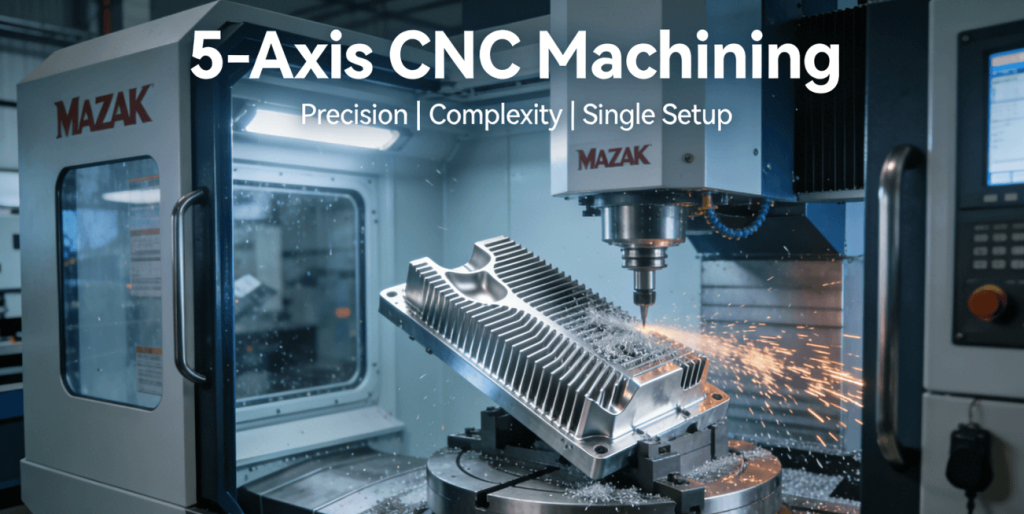
The consumer electronics industry, encompassing high-end DVD players, Blu-ray devices, and audio equipment, relentlessly pursues designs that are more compact, thermally efficient, and structurally robust. However, traditional multi-step, multi-fixture machining methods often struggle with complex geometric shapes for aluminum heat sinks or precision chassis, leading to accumulated tolerances, extended production cycles, and high scrap rates. The root cause lies in the inherent limitations of conventional 3-axis or multi-station machining, which cannot complete multi-angle and complex curved surface machining in a single setup.
This results in poor mating surface tolerances, subpar thermal efficiency, or post-assembly micro-vibrations, ultimately compromising the end product’s performance and durability. This article delves into 5 axis CNC machining technology, explaining its core principle of completing complex parts in one setup and how it fundamentally solves these precision manufacturing challenges, becoming a transformative force for critical component fabrication. The following sections will dismantle this technology’s impact through five key questions.
H2: Why Traditional Manufacturing Methods Struggle with Precision Parts for Modern High-End Audio-Visual Equipment?
High-end audio-visual devices, such as reference-grade DVD players and amplifiers, impose stringent demands on internal metal components. These include thin-walled structures, intricate asymmetrical cooling fins, and surfaces combining high-gloss and matte finishes for both function and aesthetics. Traditional 3-axis CNC 5 axis machining or stamping and bending processes face significant limitations in meeting these demands. Multiple fixtures and repositioning introduce cumulative errors, while deep-cavity machining becomes problematic, and achieving consistent surface finishes across complex geometries is difficult. These challenges lead to low yield rates and escalating costs. As noted by the American Manufacturing Technology Association (AMT), precision manufacturing is a fundamental pillar for product differentiation in consumer electronics. This underscores the critical need for more advanced machining technologies capable of handling such complexity with higher fidelity and efficiency.
H2: What is 5-Axis CNC Machining, and How Does It Break the Limits of Single-Setup Complex Part Production?
5-axis CNC machining represents a significant leap from conventional 3-axis machining. In addition to the linear X, Y, and Z movements, it incorporates two rotational axes, typically the A and B or C axes. This allows the cutting tool to approach the workpiece from virtually any direction, unlocking the ability to machine complex contours, undercuts, and inclined features in a single clamping.
H3: The Core Advantage: Unprecedented Geometric Freedom
This capability is transformative for parts like a media player’s facia with curved recesses or a non-symmetric heat sink. By enabling continuous machining of five sides in one operation, it completely eliminates errors associated with repeated re-fixturing and repositioning.
H3: Understanding the Axes of Movement
A common question is, “what are the 5 axis on a CNC machine?” Typically, they are the three linear axes (X, Y, Z) and two rotational axes. In a common table-table configuration, the workpiece rotates on the A-axis (tilting) and the C-axis (rotating), while the tool moves linearly. Other configurations, like a trunnion style machine, operate on a similar principle, providing the tool-head with angular freedom relative to the workpiece.
- Achieving Micron-Level Precision
The elimination of repeated re-fixturing is key. By machining complex features in a single setup, 5-axis CNC avoids the cumulative errors from multiple repositioning steps, directly enabling the consistent achievement of micron-level tolerances critical for high-end components.
- Enabling Complex, Monolithic Designs
The single-setup nature is the foundation for achieving exceptional accuracy, often within ±0.005mm or tighter. It also allows designers to consolidate multiple assembled parts into a single, stronger, and more reliable monolithic component. For readers seeking a deeper technical understanding, comprehensive resources such as this guide on 5 axis CNC Machining are invaluable.
H2: What Core Capabilities Should Engineers Focus on When Selecting 5-Axis CNC Machining Services?
Selecting the right partner for 5 axis CNC machining services necessitates a structured framework. The evaluation should scrutinize the provider’s 5 axis machining center portfolio, as configurations like dual rotary tables versus tilting spindles suit different part complexities and tolerance needs. A deep material and machining parameter library for alloys and plastics is essential.
Crucially, the partner must offer proactive engineering support and Design for Manufacturability (DFM) analysis to optimize parts for cost and performance. Robust quality systems, evidenced by certifications like ISO 9001 or IATF 16949—with leaders like JS Precision often holding AS9100D—are non-negotiable. Finally, the ideal vendor ensures a seamless transition from rapid prototyping to stable, low-to-mid-volume production.
H2: Case Study: Optimizing a Critical Chassis for a High-End Media Player with 5-Axis CNC
This case examines how 5-axis technology transformed the manufacturing of a key structural component.
H3: The Challenge: A Complex, Multi-Functional Chassis
A high-end audio brand required a unified internal chassis for a media player. This part needed to integrate motherboard mounting, hard drive bays, and engineered air ducts into one piece, demanding exceptional rigidity and vibration damping. The traditional approach of welding multiple fabricated pieces was heavy, inconsistent, and costly to assemble.
H3: The 5-Axis CNC Solution
The brand partnered with a specialized 5 axis CNC machining factory possessing the necessary expertise. JS Precision engineered a solution to mill the entire chassis from a solid block of aerospace-grade aluminum in a single setup on a advanced 5-axis machining center.
- Enhanced Performance and Weight Reduction
The monolithic design, machined from a solid aluminum block, eliminated welded joints and fasteners. This resulted in a perfectly rigid, vibration-damped structure that was significantly lighter, directly improving the device’s acoustic performance and portability.
- Cost Reduction and Superior Quality
The outcome was remarkable: a 35% reduction in weight paired with a 50% increase in structural rigidity. All mounting surfaces were machined to extreme flatness, and by eliminating assembly steps, total integrated costs were reduced by 20%. The part’s quality and traceability were assured by the supplier’s adherence to stringent management systems, including ISO 14001 for environmental management and AS9100D, underscoring a system capable of meeting the most rigorous reliability standards.
H2: Investing in 5-Axis CNC Machining Services: A Rational Evaluation of Cost and Long-Term Value
While the high 5 axis CNC machine price represents a significant capital barrier, partnering with a professional service offers a strategic and economical alternative. The value extends beyond mere cost avoidance on equipment, maintenance, and personnel. The inherent precision and single-setup capability of 5-axis machining drastically reduce secondary operations, inspection time, assembly labor, and scrap risk.
Furthermore, it grants engineering teams unparalleled design freedom to create integrated, optimized products that enhance competitiveness. As noted by the International Organization for Standardization (ISO), lean outsourcing allows firms to focus on core innovation, making collaboration with a top-tier 5-axis CNC service provider the most efficient path to leverage this advanced technology.
H2:Conclusion
5-axis CNC machining has evolved from a tool for making complex parts into a key enabling technology driving consumer electronics hardware toward greater integration, superior performance, and more reliable quality. It transforms the gap between “design” and “manufacturability” into a canvas for innovation, allowing previously cost-prohibitive or unmanufacturable monolithic precision components to reach the market efficiently. If you are developing the core components for the next generation of audio-visual equipment or any precision electronic product, it is time to re-evaluate your supply chain.
Upload your part’s 3D design files today to receive a professional DFM analysis and an instant quote. Experience firsthand how advanced manufacturing technology can empower your product vision.
H2:Author Bio
Zhang Gong is a precision manufacturing and materials engineering expert with over 15 years of experience. He specializes in the applied research and commercialization of advanced CNC machining technologies for the consumer electronics, automotive, and aerospace sectors.
H2:FAQs
Q: Is 5-axis CNC machining suitable for low-volume, high-mix production of audio-visual components?
A: It is exceptionally well-suited. The flexible nature of 5-axis CNC is a major advantage, as it does not require expensive dedicated tooling. Production can switch quickly between different parts via programming changes, making it ideal for low-volume, high-mix precision component manufacturing, which significantly shortens R&D cycles.
Q: For appearance-critical parts like a DVD player chassis, what surface finishes can 5-axis CNC achieve?
A: It can produce a wide range of finishes, from high-gloss mirrors to fine matte textures. By optimizing tool paths and cutting parameters, excellent surface quality (with Ra values potentially below 0.8μm) can be achieved directly on the machine. This reduces or eliminates secondary polishing and ensures consistent texture across complex curves.
Q: Beyond metals, can 5-axis CNC machine precision plastic parts for insulation or damping?
A: Absolutely. It excels at machining high-performance engineering plastics like PEEK, PA (Nylon), and PC. Precise temperature control and cutting strategies prevent deformation or melting, allowing for the production of intricate parts with snap-fits, thin walls, and internal geometries for insulation or vibration damping.
Q: How can I determine if my part design is suitable for 5-axis CNC machining?
A: If your part features multiple machined inclined planes or complex curves, has deep cavities or undercut features, requires extremely high positional or profile tolerances, or if you aim to reduce the number of assembled parts, 5-axis CNC is likely an efficient and cost-effective choice. A professional supplier can provide a DFM analysis for a definitive recommendation.
Q: What is the typical lead time from providing drawings to receiving first-article parts from 5-axis CNC machining?
A: For parts of standard complexity, a professional service can often complete programming and scheduling within 1-3 business days after receiving data, with first samples delivered within 1-2 weeks. The “single setup” characteristic of 5-axis technology itself greatly compresses the time typically lost in multi-operation workflow transfers.